Showing posts with label HGA. Show all posts

Wednesday, October 11, 2023

Tapestry myths--or truths??

It was great fun to participate in a panel discussion last week hosted by Handweavers Guild of America  as part of Spinning and Weaving Week.  Hosted by Julia Blake, Patsy Zawistoski and Tegan Frisino and I talked online about those weaving and spinning myths that get handed down through the generations and that ain't necessarily true.  We discussed how some myths are really just rules that are helpful for beginning spinners and weavers, and that once you get some experience working within the rules, you can understand how to break them effectively.  We talked about how some myths might start as just one person, maybe a teacher's, preferred way of doing things (warping back to front or vice-versa), and that as with most things, there is usually more than one "right" way to do something.   I held forth about how you don't have to weave tapestry on a cotton seine twine warp, or even weave over already-woven warps, or avoid linen warps, or conform to the tapestry traditions that dictate a certain size, shape, or theme for a piece to be a tapestry.  You can find the recording HERE if you were a registered attendee. 

One question Julia posed stumped me:  Are there any myths you can think of that are actually true?  Rules you maybe shouldn't break?  After the program was over, I had a few thoughts.

For the best results in tapestry, in which the weft yarns are beaten down firmly between rather widely spaced warps to make a weft-faced fabric,  tightly spun, non-stretchy yarns for weaving really are better than yarns made for knitting or crochet.  You simply need a sturdy, non-fluffy yarn to fill those spaces between the warps, a yarn that won't stretch as you bubble it in or pack down so much that you feel like it takes you forever to weave a half-inch.  Rebecca Mezoff  has written knowledgeably and extensively on this topic, and I refer you to her discussions if you're not convinced.  Yes, this means you usually have to mail order your tapestry yarns rather than popping down to the local yarn store and fondling the goods in person.  Take comfort in knowing that online stores can often stock far more options than a local brick-and-mortar place.

Does this mean you have to stick with wool?  Not at all!  Silk, linen, cotton, and more exotic fibers like stainless steel, hemp, paper and kudzu are all possibilities.  They each pose particular challenges in handling that require some practice and experimentation.  And then there are the found objects and upcycled materials . . . dried grasses and strips of plastic are two materials I'm playing with right now.  Really, the sky is the limit on wefts as long as you are willing to experiment. 

Woven sample of various blue yarns in my stash:  cotton, linen, paper, Churro, soysilk and linen, on linen warp, 8 epi

Molly Elkind, WUI 4: ashen.  Linen warp, paper, plastic survey whiskers, blue grama grass wefts, rubbed with ashes

Detail, Molly Elkind, WUI 4: ashen.  Linen warp, paper, plastic survey whiskers, blue grama grass wefts, rubbed with ashes

Another thought that occurred to me is that tension is always important.  Adequate and consistent warp tension make your weaving easier and yield a more consistent woven surface.  I re-learned this lesson recently when weaving with a wire warp.  The wire was springy and bendy and just wouldn't stay lined up nicely and in place, especially as I was finger-picking on a loom without heddles or a shedding device.  I worked around it, but it wasn't fun.   Next time, I'll use a Mirrix.  

Molly Elkind, Bivium study.  Wire warp, wool and linen wefts, survey whisker bundles.

 Consistent weft tension is also important.  Finding that sweet spot where you bubble enough to cover the warps comfortably with the just the right amount of weft takes practice.  Too little weft, too little bubbling, and your whole piece starts to draw in.  Too much slack in your weft makes little blips and bulges on the woven surface.  Sloppy, loose turns on warps can not only look bad but also push the selvedges out as they add just that little bit of extra bulk across the width of the tapestry.  Ask me how I know. . .

Indeed, when you think about it, in every fiber art tension is a factor--in crochet, in using a sewing machine, in embroidery, just to name a few--how you hold the needle or hook and pull the thread makes all the difference in the look of the finished piece.  Controlling tension is key.  (And that goes for the fiber practitioner too!)

My last thought on this topic is that basic principles of good design are not myths. Contrast is always important--contrast of value, color, shape, scale, line--this is what lends a piece visual excitement and interest.  (Even monochromatic pieces contrast with their environment, making an impact that way.)  Some contemporary artists might disagree, but I'd also say that unity, or at least coherence, is a key principle of successful design.  As a viewer, I want to sense that a piece is thoughtfully put together and not a random conglomeration of materials and techniques. 

Molly Elkind, Peachtree Boogie Woogie, collaged tapestry in three layered pieces.  Cotton warp, wool, linen, metallic wefts.
This piece started as a collage of papers chosen for their interesting patterns, textures and colors.  Even though it is woven in three purposely contrasting parts, befitting its origin as a collage, its use of some  repeated materials, techniques, and  colors help to unify it. 

If you're interested in knowing more about the essentials of good design for tapestry, check out the online class I'm offering next month through MAFA Virtual.  Open to all who have a minimal background in tapestry weaving, it's all about the nine key principles and strategies for designing tapestry that I've discovered over the years. 


Wednesday, July 27, 2022

Report from Convergence 2: some juried shows

 If you've been to Convergence, you know that it is a feast for the eyes and the soul.  So much to see!  Do!  Learn!  People to meet!  It's wonderful and a tad overwhelming.  Adjacent meetings and exhibits of the American Tapestry Alliance, Complex Weavers and other groups before and after Handweavers Guild of America's Convergence add to the mix.  

In my last post, I shared the experimental small-format work of ATA's unjuried show Tiny but Mighty.  Today I'd like to share some of the standout work in some juried shows I saw in Knoxville.  I did not get to all juried shows, and my biggest disappointment is that I was unable to make it out to Maryville, TN to see the exhibit of tapestry by master weavers Jennifer Sargent, Tommye Scanlin and Pat Williams.  I heard it was fabulous.  

Sharing space with Tiny but Mighty at the Emporium Gallery was work by Complex Weavers.  These artists often work on 8 shafts or more, sometimes utilizing Jacquard looms, and also explore innovative materials and relief and 3-D effects.  The work that stood out for me often incorporated transparency, wire, and three dimensions in multiple layers.  It was dazzling and had me wondering for a brief, crazy moment if I should revisit shaft weaving.  Weavers know that it takes considerable time, effort and practice simply to master the basics of weaving traditional structures.  This work continues the modern tradition, going on 60 years now, of weaving with unusual materials in ways that explore the limits of woven structures to make a personal statement.

From Complex Weavers exhibit; Morphology I by Melanie Olde, 13.8 x 17.7 x 2.4", 
130 denier nylon monofilament; hand-dyed thread, handwoven, multi-layered, 24 shafts 

 Cascade, by Darilyn Bennett, 12.5 x 12 x 2", 24-gauge craft wire, handwoven 2/2 twill, ondulĂ© with fan reed raised and lowered incrementally, 20 increments/contour, 4 shafts.  
Winner of Heddlecraft's More with Less Award.

detail, Cascade by Darilyn Bennett

Self Reflection in the Time of Covid by Molly McLaughlin.  36 x 24 x 2", various metallic threads, 40 gauge stainless steel wire.  Theo Moorman technique variation allowing slightly open weave in both warp and weft.  4 shafts.  

detail, Molly McLaughlin, Self Reflection in the Time of Covid. 

Robin Haller, Internal Combustion.  33 x 40 x .5", 10/2 cotton, 10/2 rayon.  
Handwoven, TC2 hand-jacquard loom

detail, Robin Haller, Internal Combustion

Su Butler, Tribute to Wm. Morris, 33 x 17.5 x 1/8", 16/2 cotton, silk/wool, linen. 
Handwoven Brocatelle, hand-painting, 50-shaft drawloom, 300 single units. 
Third Place Winner, Complex Weavers 

detail, Su Butler, Tribute to Wm. Morris

Two doors down from the Emporium was the UT Downtown gallery hosting HGA's juried Small Expressions show, for work in any fiber technique and smaller than 15" in any dimension.  This is an annual exhibit that travels for two years.  If you do small-format work, I urge you to enter!  For me, these pieces stood out.     

Al Canner, Hexapod, 15 x 15 x 4"; cotton, hemp and rayon cord, glass beads.  Knotting (macrame). 


Lydia Hall, Liminal Dwelling no. 2, 10 x 9 x 3"; steel wire.  

Rebecca Smith, Transformation.  12 x 8 x 5"; cotton, wool, mixed fibers,
coated copper wire, Japanese seed beads. 


Marcia Weiss, Intersection 1, 15 x 15 x 1"; linen, cotton; double-cloth warp ikat.
  

Ellen Ramsey, Seismic Shift (Tipping Point), 8 x 9"; wool, rayon, cotton and linen; handwoven tapestry


Kady Ambrose, Receipt Paper Basket, 13 x 7 x 9"; receipt paper, rattan, oak rim;
stake and strand basketry

With two notable exceptions, work in neutral tones seemed freshly eloquent to me.  Work that pushes into relief or three dimensions, work that recalls the forms and techniques of basketry but pushes beyond into sculpture, spoke with a strong presence. Ellen Ramsey's flat tapestry, Seismic Shift (Tipping Point), adopted a non-rectangular format that reinforced her concept.  Each of these works employed simple materials to make a strong, straightforward statement.  I will be pondering these thoughts as I move forward in my own work.  

My next report from Convergence will look at work in HGA's juried basketry exhibits from 2020 and 2022, the Leaders and Interns exhibit of 2022 Convergence instructors, and a few snaps from classes I taught and took.  


.

Wednesday, March 30, 2022

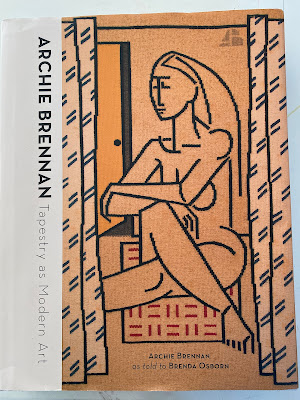
Book Review: Archie Brennan: Tapestry as Modern Art

Note:  If you are a member of the Handweavers Guild of America (HGA), you may have seen a shorter version of this review in the most recent issue of the magazine for members, Shuttle Spindle Dypepot.  Here I expand on that review with additional thoughts.  I am grateful to HGA for allowing me to review this book and urge you to join if you are not already a member.

I am thrilled to recommend wholeheartedly this book about a figure so influential in modern tapestry that he is known among weavers by just his first name:  Archie.  Though I never had the privilege of meeting or studying with him, I will presume to use his first name here.   This book, by "Archie Brennan as told to Brenda Osborn," compiles many of Archie's writings, his memoirs about his life, travels, and career, and best of all many photographs of his work.  If you are a tapestry weaver you absolutely need this book to understand contemporary tapestry.   And if you're not a weaver, I bet you'll still find the book fascinating for the details of Archie's life and training and for his thoughts about how weaving and fiber art connect to the wider art world, and simply put, how pictures are made.  

Published by Schiffer Publishing 2022; widely available 

Brenda Osborn was a longtime member of the "Wednesday Group" of weavers who gathered with Archie and his partner, weaver Susan Martin Maffei, on a regular basis for years to learn together.  The book is clearly a labor of love and a testament to a weaver and teacher who had a profound impact on all his students, and on the students of those students.  If you are new to the field or like me, want to study "with" Archie, go HERE to learn more.  This website has a link to a series of videos Archie made that are incredibly detailed demonstrations of tapestry tips and techniques.  I know several weavers swear by them.   

It was deeply thought-provoking to study the images of Archie's work and to read his writings.  I find much to agree with.  For example, Archie describes his work as "graphic, pictorial, often narrative" but always "a creative journey of discovery rather than a reproduction of a prepared design."  For me, weaving is definitely a journey of discovery, each and every time, but it's rarely narrative or even pictorial in the usual sense.  While I would love to get to the point of being skilled enough to weave without a cartoon, as Archie did, I'm not (usually) there yet.  And to be clear, Archie always did numerous studies and sketches that informed his pieces.  But his larger point has hugely influenced weavers today:  that the imagery in tapestries should appear as if it could only have been made by weaving, not by painting or photography or any other medium.  Archie championed the individual artist/designer-weaver, even though he apprenticed at the Dovecot Studios in Scotland and helped to found the Australian Tapestry Workshop.  

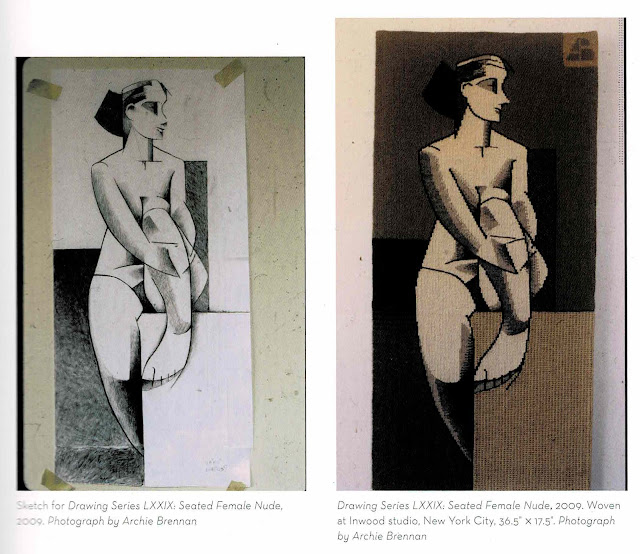
Archie writes that his work has been "a continuous search for a personal graphic language, the nature of woven drawing that is unique to tapestry."  I think most practicing weavers would agree that their work is an ongoing search for a personal voice and vocabulary in tapestry.  Archie's reference to drawing gets at a key point:  during his seven-year apprenticeship at the Dovecot, Archie was required to attend drawing classes four times a week.  Drawing remained a lifelong practice and the bedrock of his tapestry work.  He participated in life drawing sessions with live models for years.   Archie's genius is fully evident in the Drawing Series of tapestries based on these sketches.  They masterfully simplify line and shape in a way that honors and emphasizes the grid of the loom.  Rather than weaving from the side in order to smooth out steep vertical curves, he wove from the bottom up and exaggerated the "steppiness" of these lines.  Archie's love of the drawn line--and perhaps his color-blindness--explain a great deal about his own artistic style.  He is not a colorist who revels in subtle yarn blends; his work is bold, graphic, and focused on line and pattern above all.  


Archie Brennan, Sketch for Drawing Series LXXXIX:  Seated Female Nude, 2009  
and [tapestry] Drawing Series LXXIX:  Seated Female Nude, 2009.  36.5" x 17.5" 
Both photos by Archie Brennan. 

For me, it was fascinating to read Archie's account of his brief flirtation with what he calls "the new wave" of fiber art that exploded in the 1960s and 1970s.  These weavings eschewed pictorial imagery and exploited unusual and coarse fibers, hairy textures, massive size, and three dimensions, pushing weaving toward sculpture.  This style has been rediscovered by weavers today.  He writes that he realized, "The history of pictorial illusion in weaving was what intrigued me," and he revels in the "intimacy" of a tapestry that whispers rather than shouts, "savoring the delight of accumulating detail."  Weavers today can choose to work in either of these modes, and it is helpful for those of us like me who are still trying to decide whether to weave "Objects or Pictures?" (or both?) to read his thoughts.  

In a 1996 essay, Archie describes how today's weaving artists have sought to gain for tapestry a status equal to painting in the contemporary art world, and he thinks this is a mistake.  He writes that his many woven postcards and parcels are partly intended to poke fun at this ambition.  For him treating tapestry solely as art for the wall ignores a history in which in many places and times it has served other purposes.  Tapestry as Art "neglects a potential role that is unique to tapestry" which includes among other elements, the element of time.  In one of the several excellent essays by those who knew and worked with Archie, Mary Lane writes that "Brennan's pursuit of meeting tapestry on its own terms, his eschewal of descriptive color and his use of the grid allies with artists who favored the means of representation over the subject of representation."  This is something to ponder.  Indeed, I have read the book once, but I plan to reread it, cover to cover, soon, to further absorb Archie's views and clarify my own intentions and practice. 

If you are a tapestry weaver, you may already be reading this landmark book and you will surely see several reviews of it in the coming weeks.  Rebecca Mezoff has written a thoughtful review here.  My post here does not pretend to be encyclopedic and I certainly cannot add any contextual details of having met or studied with Archie.  But I hope this post suggests that if you take the time to read the text as well as savor the photographs, it will inform and challenge your thinking about what you weave, and why. 


Wednesday, April 10, 2019

What ever happened to those daily practices?

This is a sheepish post, and not just because it's about things made with wool yarn.  (yuk-yuk)

With some fanfare I announced to the world in January that I would undertake two daily practices this year:  1) a tapestry diary in which I work through the techniques in Mette Lise Rössing's book The Thread's Course in Tapestry and 2) a perpetual journal of botanical drawings, inspired by Lara Gastinger (@laragastinger and #lgperpetualjournal on Instagram).

I have done OK with the tapestry diary, but I haven't woven every day by any means.  So far I've done 39 techniques in about 100 days.  At this point, here's where it stands.  I chose to work in the wintry palette of northern New Mexico for the first quarter of the year.  I'm looking forward to updating the palette with a few yellow-greens soon.  They are starting to appear, oh so slowly, here.

Molly Elkind, tapestry diary in progress, (c) 2019
 I knew that with my teaching schedule and life intervening in general that I wouldn't weave every day, and that's fine.  Eventually I will finish.  The tapestry diary is supposed to be fun, in my book, not homework.  I had an aha moment when I realized that at the end of the year I'd like to be able to connect each technique in the book to its bit of weaving in the tapestry, so that I can use the diary and the book as references.  So I took a photo of the weaving so far, printed it out life-size, and cut out each little daily bit and glued it right into the book (gasp!).

page of Rössing's The Thread's Course in Tapestry, with my cut-and-pasted additions
I've always liked the idea of making my own textbook and this certainly makes Rössing's excellent book even more useful for me.

As for the second daily practice, the perpetual journal, I did start it with great enthusiasm, but then, it was winter.  Winter went on and on.  And on.   It was harder to get outside and find things to bring in to draw.  And meanwhile life got very very busy.  So while I've enjoyed very much seeing what other people are drawing in their perpetual journals on Instagram, mine has been stalled here.  I hope to get back to it, really I do.

bent stalk of gramma grass

It's about priorities, isn't it?  And my main focus these days is making work for the upcoming Eldorado Studio Tour May 18-19, here in Eldorado, New Mexico, near Santa Fe.  I'm hoping to have three pieces in my series of wedge weave skies, and another three pieces in the new Fences series, in addition to work from last year's show in Atlanta.

Virga, (c) Molly Elkind, 2019.  Cotton.  7.25" x 9.25" 
I had great news last week--one of the wedge weave skies, Virga, has been accepted to the Small Expressions show sponsored by Handweavers Guild of America.  So while it won't be available for the Studio Tour, it will get to travel a bit.  I guess I'd better get back to the loom. . . .


Friday, December 21, 2018

Weaving community: a whole lot of gratitude


Yarn ball Christmas tree with moomintrolls who might be up to mischief.  Thanks to Rebecca Mezoff (and Emily) for letting me steal their idea for the tree.  Moomintrolls are characters from Finnish folklore.
At this time of year, if we are lucky, we celebrate the winter holidays with family and friends.  We celebrate friendship and love and laughter, and we are grateful not to be alone in the darkest part of the year.  We look back over the past year, recalling the good times and the bad (and the weird and the downright ugly).  With luck we might estimate that the good outweighed the hard.

I was thinking this morning about how fortunate I have been to be part of a sustaining artistic community every part of the way in 2018.  In the Atlanta area, I found my tribe at Southeast Fiber Arts Alliance (SEFAA), which hosted my show of tapestries in February and March.  I was honored to have friends not just from my neighborhood but weavers from Florida and North Carolina, come to see the show and give me their considered feedback.  You know who you are, and I am grateful!

Opening reception for ICONIC show at SEFAA.  Photo:  Nancy Langham
When we moved to New Mexico, I left one community and was humbled and so happy to be welcomed into another one.  The Las Tejedoras,  High Desert Tapestry and Las Aranas guilds have become my local fiber tribe.  It is thrilling to be among so many dedicated weavers.  I am looking forward to teaching Collage to Tapestry Cartoon at Espanola Valley Fiber Arts Center (EVFAC) in February and deepening my connection with several weavers there.*

One of the best things to happen to me in 2018 was the Handweavers Guild of America's Convergence conference and the subsequent American Tapestry Alliance meeting and retreat.  It was fantastic to meet, teach and weave alongside gifted artists from across the country.  The workshop with Rowen Schussheim-Anderson has changed my approach to tapestry in exciting ways.

Next year will afford me the chance to teach in four locations around the country, and I am deeply grateful to those weaving friends (again, you know who you are) who have helped me make those connections.

Finally, I continue to be grateful for the online community I have found on Instagram and Facebook.  I am as dismayed as anyone at the ongoing revelations about Facebook's cavalier attitude toward users' privacy (to put it generously), but I continue to feel that what I learn there from fellow artists and weavers far outweighs the negative.  Instagram has introduced me to fiber artists worldwide whose work inspires and teaches me something almost every day.

Last week I was touched to get thoughtful and valuable feedback on both social media when I publicly asked for help figuring out how (or if) to handle next year's tapestry diary.  (If you're wondering, I've reached a decision but I'm saving it for the next blog post!)  Weaving is a solitary pursuit, but sharing our work in progress, our questions, doubts and occasional triumphs makes it all easier.

I suppose it's not surprising that weavers are good at coming together, constructing a sturdy fabric in which each thread is a small but indispensable part of a larger, beautiful whole.  As I look back at 2018 and forward to 2019 I hope to continue to be one of those interlaced threads.

Santa Fe Plaza 
I wish for you, my friends and colleagues near and far, all the blessings of community wherever you are and whatever you do.  The online community is wonderful, but let's remember to get out of the studio and make connections in real life too!  Keep an eye out for those solitary threads who might be snagged or unraveling, and bring them into the web.  We're all in this together.


* There are still openings in the class at EVFAC.  Click HERE to register.

Wednesday, July 18, 2018

Small Expressions 2018: Juried Small Format Fiber

While attending Convergence in Reno I had the chance to view HGA's annial juried exhibit of small format work called Small Expressions.   (Last week I wrote about the American Tapestry Alliance's unjuried small format show limited to tapestry; this is a different exhibit.)  Work could not exceed 15" in any dimension, and had to use one or more fiber techniques.  Virginia Vogel juried the show this year and as in the past, works that broke with conventional fiber practice were prominent.  Pieces by 28 artists from all over the world were selected.  (While I have been selected for this show in the past, I did not enter this year.)

The exhibit was on view in the Wilbur D. May Museum and beautifully displayed in a white gallery of just the right, intimate size for such a show.  I found myself drawn, especially in retrospect, to the works which departed from the expected and which had relief or three-dimensional aspects.

This piece, Reflection, by Rebecca L. Smith won First Place.  Rebecca makes the wedge weave technique her own by incorporating seed beads and by using wire to shape the piece into a relief at least an inch deep.

Rebecca L. Smith, Reflection, 12" x 12".  wool, other fibers, seed beads, wire

Rebecca L. Smith, detail Reflection

While this piece by Jenny Schu entitled Leaf Me Alone 1 also incorporates seed beads, I was captivated by the expert weaving of text in different fonts, even backwards text.

Jennifer Schu, Leaf Me Alone 1, 10" x 15", hand-dyed rayon, glass seed beads
Jennifer Schu, detail  Leaf Me Alone 1
(Apologies that the color in the detail shot is off; the first photo is more accurate.)

This piece called text and manuscripts to mind in an abstract way.  It's Silences, #4 by Julie Lambert, woven of paper thread.  I love the simple elegance of this work, the way in which the materials and technique carry the entire weight of the design and concept.  It's beautifully displayed, but I wish I could tell whether it is bound in the center like a book or is a scroll.

Julie Lambert, Silences, #4, 15" x 4", paper thread

Julie Lambert, detail Silences, #4,

I was fascinated to study Deanna Deeds' piece Dialogue, woven of cotton and nylon filament, trying to figure out how it was done.  It seems to me to be an investigation into the very nature and structure of weaving.

Deanna Deeds, Dialogue, 15" x 15", cotton, nylon filament
Deanna Deeds, detail  Dialogue


As I write this I'm noticing I--and perhaps the juror--have a bias toward relief and 3D work.  In her tapestry Abstract Earth, Penny Collins expertly handles shading so that there is a teasing, now-you-see-it, now-you-don't illusion of depth when one steps back.  What seems to be a flat surface hints at topographical relief.

Penny Collins, Abstract Earth, 13" x 13", wool, cotton

Penny Collins, detail, Abstract Earth
Finally, two fully three-dimensional pieces showed that fiber can be every bit as sculptural as other, sturdier materials.  In this piece of crumpled handwoven fabric Jessica Pinsky has frozen a momentary gesture--of frustration?  Weaving can do that to a person!


Jessica Pinsky, Anxiety Series 1, 11" x 8", silk warp, cotton weft, resin

Jessica Pinsky, detail Anxiety Series 1
Aviva Peres,  Double Reason to Celebrate,
8" x 8", vintage cotton, vegetal stiffener, wire thread

Aviva Peres,  Double Reason to Celebrate
This piece truly does feel like a celebration, with its coils and tendrils exploding in all directions.  I love how it looks so different from different angles.  There are continuing surprises and discoveries for the eye to make.

Wherever you are this summer, I hope you have the chance to take in some exciting art! 


Wednesday, November 29, 2017

Convergence. Reno. July 2018.

This post will be of particular interest to my weaving friends out there.  Weavers know that Convergence, the biennial international fiber conference hosted by the Handweavers Guild of America (HGA) is not to be missed.  There's a huge slate of workshops and classes, a vast vendors hall, fiber art exhibitions, a fashion show, talks and field trips and tours. You can view the schedule of all the events  HERE.  And of course, there are lots of weavers walking around in their jaw-dropping handmade creations, giving each other the "weaver's handshake" (you know what I mean!).

I'm thrilled to be going back this year for the second time as an instructor.  I'll be offering two classes:  a 3-hour seminar called "Plan Your Tapestry Diary," and a two-day workshop called "From Collage to Tapestry Cartoon."  Both are geared to tapestry weavers who have some familiarity with basic principles and techniques.  Beginners are welcome.

Priority Registration opens today, November 29, at noon EST and runs until Dec. 6 at noon EST, when regular registration opens.

Molly Elkind,
2017 tapestry diary in progress (March - July visible)

"Plan Your Tapestry Diary" is just what it sounds like.  If you're curious about why so many tapestry weavers have adopted a daily practice, this class will answer your questions and help you plan your own.  We'll look at lots of examples of diaries and discuss the many possibilities for format, size, theme and techniques.  For me the most important benefit of keeping a tapestry diary is that I can play, learn, and practice techniques in bite-size chunks (as little as 15 minutes) every day.  Every diary is as unique as every weaver--you make the rules, and you can break them.  (You can see in the photo above how I've changed up the rules each month in my own diary this year.) And you don't need to wait for January 1 to start yours!

There's no need to bring a loom or yarn for this class--just pencil and paper.  A basic familiarity with the tapestry process is helpful.  Go HERE and scroll down to 3-hour seminars on Friday afternoon for the details.

cropped portion of collage
Molly Elkind, "Huh?"
4" x 6" tapestry inspired by collage

"From Collage to Tapestry Cartoon" is geared to tapestry weavers who want to explore ways of designing for tapestry that don't start with drawing or painting.  You will gets lots of hands-on experience with collage, consider what makes a good design, and--this is the exciting part--explore how to translate your cut-and-pasted collage into a weaveable cartoon.  How will you convey the colors, textures, lines and shapes of your collage in tapestry weave?

Again, there's no need to bring a loom for this workshop.  We will focus on design and making a cartoon; you will leave with a design (maybe more than one?) ready to weave.  The supply fee is minimal and all you need to bring is blank paper or sketch book (8 1/2 x 11"); colored paper or old magazines in variety of colors, textures and patterns, and glue sticks, markers and/or colored pencils.  I'll share from my stash of interesting materials as well.

Molly Elkind, collage for Mary (greater is what she bore in her mind)

Molly Elkind,
Mary (greater is what she bore in her mind), handwoven tapestry, 2015
Questions?  Email me or ask in the comments below.  Hope to see you in Reno!

Wednesday, August 31, 2016

HGA's Small Expressions exhibit: Yep, more innovation

I've been sharing with you some of the work I saw in Milwaukee in connection with Convergence. The Handweavers Guild of America sponsors a biennial show entitled Small Expressions for fiber work under 15" in any direction.  This year it was on view at the Milwaukee Art Museum.

The Milwaukee Art Museum's Burke Brise Soleil winged sunscreen, designed by Santiago Calatrava.  
When we left the "wings" had closed and wedding parties were taking turns getting photos. 
This museum is a destination in itself, for its spectacular architecture and for its wonderful collection of modern art, the Mrs. Harry L. Bradley Collection.

But our first stop was to see Small Expressions.  I was struck by how each artist pushed her materials beyond their usual scope and modes of expression.  As I saw in ATA's unjuried small tapestry show, the small format seems to encourage risk-taking and inventiveness.

Tapestry weaver Rebecca Smith used wire and beads as well as yarn to create a woven relief that pulls you in close to explore changes in surface detail.

Rebecca Smith, Tapestry Relief, tapestry and bead weaving, 8 x 11 x 1"

Kelsey Leib transformed wool and wood into this trompe l'oeil bouquet.  

Kelsey Leib, Ghost, wet felting, 10 x 6 x 3"
As a former paper maker and occasional shibori dyer, I marveled at Barbara Chappell's relief piece made from linen paper yarn.  The restrained color palette allows the fine pleated textures to take the starring role.  What sort of spectacular butterfly emerged from this gorgeous cocoon?

Barbara Chappell, Entwined, handwoven, shibori pleated, sculpted, 7 x 6 x 2"
I studied this next piece for quite awhile, trying to determine how weaver Genevieve Moisan had incorporated brocade and mohair so seamlessly.  What fantastical narrative is unfolding here, between the hatted figure and the bird-woman?

Genevieve Moisan, Dark, brocaded Jacquard weaving, mercerized cotton, black mohair, orlec, muslin,
wooden stretcher, 12 x 15 x 1"
Here you can zoom in a bit to see the brocade weave in the ground.  I'm sorry the photo resolution is not as fine as it could be.

Genevieve Moisan, Dark, detail
My personal favorite, though, was this piece that surprised me by combining broken crockery and crocheted wire.

Mirva Kuvaja, Archeology, freeform crochet, copper wire, found porcelain pieces, 8 x 8 x 1"
Old broken dishes can be a well-worn path to easy sentimentality.  But the artist has left the shards as shards, rather than trying to crochet them back into some kind of wholeness.  They seem to have sunk to the bottom of their background in a random way that suggests the way they may have been found on the ground.  The small-scale intricate crochet, carefully fitted to each broken piece, seems like a tender act of mending/embellishment to me.

I see that in almost every case here I have focused on the artist's inventive use of materials, her innovative technique.  Fiber is a medium obsessed with materials, their textures and colors and malleability, so it is natural for us to be drawn first to these.  And yet I am always preaching to my students not to focus on technique alone, but to be sure they have something to say, that their image and concept are worth the viewer's time and attention.  Surprising use of materials may grab our attention at the outset, but visual delight and engaging ideas and stories will keep us looking.  In this I think these artists have succeeded as well.  What do you think?