Showing posts with label Ruth Manning. Show all posts

Wednesday, June 21, 2017

From Ab Ex to wedge weave

In January I wrote about a visit to the Women of Abstract Expressionism show at the Mint Museum in Charlotte. Here's a detail of one painting by Joan Mitchell that I especially liked:

detail, Joan Mitchell, Cercando un Ago, 1957
I concluded that post this way:

"I was surprised to find that while gazing at work with so much energy, movement, and color, I felt a paradoxical stillness and calm.  A meditative reflectiveness that I feel in front of . . .  weaving.  Of course I started wondering if there was some way to bring the energy, movement and spontaneity of this kind of painting to tapestry weaving. 
But that's a story for another day."  

Well . . . today is another day!  At the recent retreat of Tapestry Weavers South,  Connie Lippert introduced us to her signature technique, wedge weave.  It's a lot of fun, seems to go quickly, and while it's quick to learn it has an amazing potential for variety.  Just check out Connie's website for some fabulous examples.  You can also see some lovely wedge weave tapestries on Michael Rohde's site, clicking here, on the "small tapestries" link under Galleries.

So this for this month's tapestry diary I'm doing wedge weave.  The "rules" are that I'm using only yarns from my scrap bag, and that there are five horizontal bands, one for each week of the month. Here's where the diary stands today, roughly in the middle of the fourth band:


I'm having fun playing with color, seeing how I can make disparate colors work together by using the right proportions.  You can see that I'm not weaving the full 7" width.  As I'm weaving, it is 5" wide and will be 7" tall.  It will be turned sideways in its final form, so that the long, scalloped edges will be the top and bottom.

I'm pondering whether I can use wedge weave in the background of my next Mary piece.  I'm immensely encouraged by these tapestries which fuse imagery with wedge weave.

Connie Lippert wove a map of the world entirely in wedge weave.

Connie Lippert, Paradise Lost?, wool, linen, natural dyes.  32" x 47"

Ruth Manning has recently finished Donut Man.  You can read about it on her blog.

Ruth Manning, Donut Man 
I am transfixed by the way Ruth has integrated realistic imagery into a wedge weave background. She has handled the wedge weave areas with such subtlety, blending colors and values so that they do not shout Zig! Zag!  I love the tones of white and beige in the upper right, and the hatching in the top center.  The man eating the donut is the still focal point in a busy, blurred background full of movement.  There is much to see and learn from here.  Thank you, Ruth!

I'm hoping I can achieve a similar feeling of the still, iconic Mary at the center of the tapestry I'm planning.  Here's a sample where I'm experimenting with yarns and colors. The large striped wedge at the top is my attempt to make one of Silvia Heyden's "feathers."  Click here and here for more about Silvia.  She worked improvisationally in something very like wedge weave.


Here's a few sketches of the next (last?) Mary piece.  I'm thinking of it as a companion to the Mater Dolorosa (sorrowing mother) I just finished--same size, similar Churro yarns, but with a different mood.  Working title:  Mater Potens (powerful mother).  I'm not finished with the design process yet, though, so stay tuned for changes.


Wednesday, August 24, 2016

More fiber innovations at Convergence

There was so much good fiber work on display at Convergence it was hard to fit it all into one post. Last week we looked at the exhibit of work by teachers at Convergence; this week we'll see work from ATA's unjuried small format show .  I'll look at  HGA's Small Expressions exhibit in the next post.  I was struck that in both shows, the small format, rather than limiting artists' creativity, seems to liberate them to experiment and innovate.

ATA's Tapestry Unlimited show was held at Milwaukee's gorgeous downtown public library.  What a grand setting!


Ruth Manning did a fabulous job of gathering the tapestries, mailed in from all over the world, mounting them with thought and care on black panels, and then installing them on the library's second floor.  You can read about her labor of love HERE.


This shot gives a sense of the variety of responses to the challenge to weave a tapestry under 10" in any direction.  Clockwise from upper left:  Maggie Clark, Golden Feather; Heather Myers, Turnip Crop; Karen Fowler Little, Cloud Big City; Suzette Taylor, Alexander 2014; Beverly Weaver, Kansas Series #2--Tallgrass; Alyssa Meredith, Metaweave #1:  Trellis; Linda Whiting, Poppy.

Many of us revel in the opportunity to explore color in weaving--but a number of weavers showed how powerful black, white and gray can be.  This weaver broke free of the standard rectangular format as well.

Nancy C. Crampton, Playing with Pattern
The group GobelArtki undertook a specific challenge to explore texture, shape, and line by avoiding color in their tapestries.  Again, four very different approaches show the versatility of the simple over-and-under of tapestry weaving, as well as the graphic power of black, white and gray.

Clockwise from left:  Ewa Elsner, Lady; Ewa Kaminska, Japanese Dance,
Ilona Wroblewski, Dance, and Dorota Wronska, Cat.
These pieces caught my eye for their sheer mastery of design and technique.   Graceful curves can be difficult to achieve in the standard grid of tapestry.

Top:  Patti Kirch, Tapestry Letter, Two Zines please;
Bottom:  Alex Friedman, Curlique
Landscape and nature motifs can be difficult to render with subtlety in tapestry  (at least for me so far) but these artists did so beautifully:

Joan Griffin, Keukenhof

Minna Rothman, Cape Cod Sandbars

D. Colette Wright, Autumn Beauty
Faces, especially selfies, were a popular subject.  This is part of a collection done by the Damascus Fiber Arts School to honor their mentor Audrey Moore on her 90th birthday.  


I love the way this face was abstracted and colored.  

Liz Pulos, Self
I love how Mariana Ortega left warp--and loom--visible in her piece.  It reinforces the sense of a person at wit's end, possibly unraveling.

Mariana Ortega, No Desesperes

Me with my tapestry Mother/Mary (red border).  That's Robbie LaFleur's Edwin, Home from the Great War at bottom.
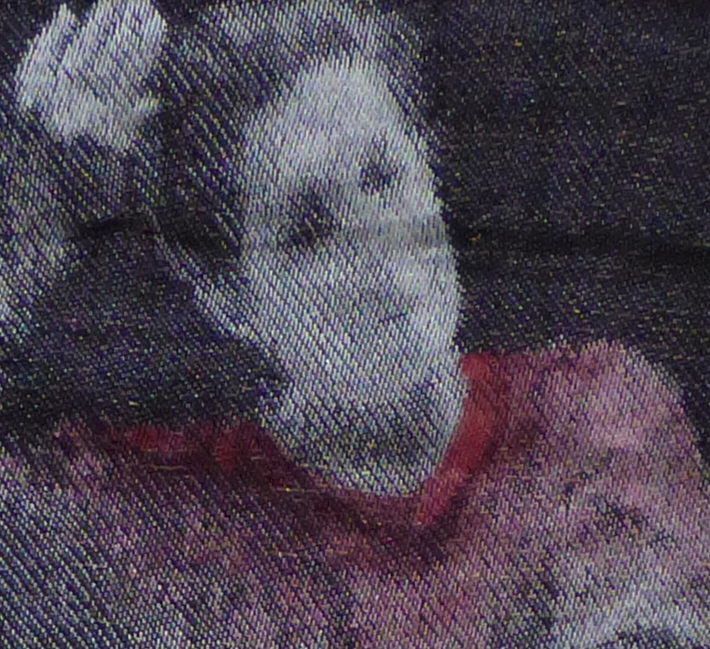
Finally, I have to include the face that I brought home with me, Ruth Manning's Feather Hat.  I love this little piece!  I was disappointed that I couldn't take Ruth's Convergence workshop in weaving faces, but now I get to smile at this gal every morning.  I love how Ruth mounted her on a small painted canvas, and how she let the linen warps become an important part of the piece.  This lady reminds me not to take my hair too seriously.  

Ruth Manning, Feather Hat

Wednesday, August 17, 2016

Fiber innovations at Convergence exhibits

One of the best parts of attending a conference like Convergence is seeing what other fiber artists are doing.  There were several exhibits associated with the event, and I was honored to be in two of them!  As always I was struck by the variety of expressions possible in fiber, and by the sheer inventiveness of other artists.

The work of teachers at the conference was on display in a show called Gathering by Waters.  There were many pieces I really liked.  It is hard to choose which ones to share with you, but  here are a few:

Marcia Weiss, Water Lily, warp ikat, linen
I love the simple abstracted design and the gorgeous color of this ikat.  The blurred, watery edges of the shapes perfectly suit the subject and allude to the dyeing process involved.

Kathleen Zasuwa, Ancient Grafitti:  Lines to Letters, 8-shaft undulating twill, cotton, wool, silk,
metallic threads, patinated copper cut into strips
I love how Zasuwa used copper strips in combination with a traditional weave structure to make an enigmatic diptych.  I wonder how she kept the cut copper edges from cutting the other threads?

Another artist also used metallic threads to make an affecting image: 

Louise Lemieux Berube, Flower #1, Jacquard weaving with pigments,
Tencel, stainless steel, copper, linen, wool
detail, Berube, Flower #1
This piece made me smile.
Hollie Meltzer, Lossy Format #1, crocheted "pixels," cotton floss, thread, poly organza backing
detail, Hollie Meltzer, Lossy Format #1
I just think it's terribly witty and maybe a little crazy to crochet approximately a billion tiny (about 1/2" diameter) circles to render a classical image in a pixelated format.  It feels very contemporary.  "Lossy format" indeed!

Hollie Meltzer did another pixelated face in a very different technique: 

Hollie Meltzer, Blow-Up, reverse applique, machine and hand stitching,
poly organza, cotton fabric, poly and cotton thread 

detail, Hollie Meltzer, Blow-Up
Where's the reverse applique?  The top layer of white poly organza is selectively cut away within the stitched grid to reveal gray fabric underneath.  Many of these gray squares are then hand-stitched with varying densities of dark line to make further value changes which in turn create the very blurred, pixelated image.


Sarah Warren, Long Night over the Canyon, Navajo wedge weave, cotton warp and hand-dyed wool weft
detail, Sarah Warren, Long Night over the Canyon, Navajo wedge weave, cotton warp and hand-dyed wool weft
I'd never seen wedge weave used to portray a landscape,  It seems like the perfect union of subject matter and technique to me, capturing the colors and stark landscape of the southwest.

Molly Elkind, Red Letter Day, tapestry, cotton, wool.
I'm honored to be in good company, next to a tapestry by Ruth Manning! 
I saw two other shows as well; those will have to wait for my next post.  The American Tapestry Alliance (ATA) had its very popular unjuried small format (under 10" in any direction) show. Tapestry Unlimited, at the downtown Milwaukee public library.  And  HGA's biennial Small Expressions exhibit of fiber pieces was at the fabulous Milwaukee Museum of Art.