Showing posts with label exhibits. Show all posts

Saturday, May 13, 2023

Where should you show your work?

 You’ve been making your tapestries (or other fiber art) for a while now and frankly, your work is pretty good!  You’d like to to get it out there. Where do you start?  Maybe you already share your work on social media, but you’d like to show in physical shows, maybe even juried exhibits, where more people can see your pieces up close.  

If you’re a member of a local weaving guild or art center, their member shows are a great start.  Volunteer for the hanging committee, or to be a scribe for a visiting juror or judge, to get behind-the-scenes experience in what’s involved in putting a show together.  The more you know about what’s involved, the better prepared you will be to mount, present, and pack your work. 

Applying to juried shows is a whole ‘nother ballgame.  Here you are competing against dozens or hundreds of other artists for the chance to have your work seen by a knowledgeable expert and by viewers in an art venue. To find out about juried exhibits you can enter, look for Calls for Entry in your favorite fiber arts publications, and sign up for emails from CaFE, the online clearinghouse of exhibit opportunities across all media. Here are some of the main things to keep in mind when you apply to juried exhibits:

    Photography, photography, photography.  The importance of submitting high-quality photos of your work cannot be overstated.  Your photo is the only way jurors can see how wonderful your work is; make sure it does your work justice.  Learn how to take your own excellent photos or pay a professional (I have always found it to be money well-spent).  Photos must be in focus, free of distracting backgrounds, well-lit and without shadows, straight and square within the frame, and free of fingers and toes poking out around the edges!  What’s good enough for friends on Facebook is most definitely not good enough for submission to a juried exhibit.    


Molly Elkind, WUI 8: sky/cable.  15" x 12" x 1.5"; cotton, wool, plastic survey marker.  2023

I took these photos with my phone and cropped them with Photoshop Elements.  The lighting is not perfect but in my view the shadows are not distracting. In the detail shot I zoom in on a part of the piece that gives a good look at everything going on in the work.  I am thrilled that the juror for the Surface Design Association exhibit Safekeeping selected this piece for the show. 

The second part of taking good photos is understanding how to edit them to be the required size and resolution, and to crop out or straighten any that are perhaps a tiny bit wonky.   Jurors and exhibit organizers will not spend the time to fix your photos for you; they will disqualify you and move to the next entry. 

     Read the prospectus or call for entry very carefully, and follow it to the letter. Re-size photos exactly as asked. Label them exactly as directed.  Include a bio, statement, and other information exactly at or less than the number of words or characters specified.  Spend some time crafting carefully worded, clear text about yourself and your work. If the exhibit has a stated theme, explain how your work is related to the theme.  We live in a time when, for better or worse, the words you use about your work matter just as much as the work itself.   Again, jurors don't have time to guess what you're trying to say or edit your writing. 

    If you are entering a number of shows at the same time,  check very carefully the deadlines for entering, notification dates, dates that your work is due for delivery to the venue (unless of course it’s an online exhibit), and return shipping or pick-up dates.  Try not to make the rookie mistake of entering two exhibits with overlapping exhibit and shipping dates at the same time!  Jurors and gallery people get very annoyed when this happens, and it doesn’t help your image as a professional.  

    I use a table like this to track the shows I've entered.  When I fill in all the relevant dates for shows I'm thinking of entering, I can see right away if I'll have a conflict.


    Check your ego at the door.  Fine and well-crafted work is rejected from juried exhibits All. The. Time.  Many factors that have nothing to do with your specific piece or your own worth as an artist go into selecting or rejecting work for an exhibit.  Dust yourself off and submit somewhere else.   Keep at it.  

    Once you’ve had your work accepted into a number of juried shows, you may start to be more selective about where you apply. Consider the venue and the juror.  Is the juror someone whom you think will be receptive of what you do, or someone you want to introduce your work to?  Is the venue or exhibit a prestigious one?  There are many many juried all-media exhibits at many small, out of the way local art centers, that when you are accepted will give you a line on your resume but not much else.  This may be all you need as you establish yourself, and that’s fine.  Only you can judge which exhibits are worth applying to.  Try not to be seduced by the potential for selling your work or winning one of the advertised awards or prizes. In my own experience, work seldom sells at juried exhibits, and prizes are even rarer!

   So why do it then?  Be clear about your own goals above all.  Why do you want to show in a juried exhibit?  For myself, it's a way to share what I do with the wider world, and to take part in the ongoing conversation about tapestry that's always happening among weavers.  It also builds my credibility as a professional visual artist. 

This leads me to my last point, a story about choosing venues.  I’ve had the good fortune to have the chance to show an entire body of work, 10-15 pieces, twice so far this year.  The first time was in a two-person show in Farmington, NM.  The work was sensitively hung in a beautiful well-lit art gallery on a college campus.  It was a gorgeous installation.  However, the opening reception was poorly attended, I knew no one in the community, and I have no idea how many people ultimately saw the work.  It is nice to list a two-person show on my CV however.  It shows that I am an actively exhibiting artist. 

Installation view of Whispers from the Land at San Juan College, Farmington NM in Feb. 2023.  Framed tapestries by Molly Elkind; quilts are the work of Patricia Joy.

The second exhibit is a one-person show at the local library in my community, happening right now for the month of May 2023.  As it is a very busy month for me and for the library, it was impossible to schedule an opening reception.  The work is hung above bookshelves and among book carts and signs on the library walls.  So, no reception, no beautiful gallery installation. And yet because the library is a very busy place, I suspect more people will see this exhibit than saw the one at the college art gallery.  And that’s just fine.


Installation views of Woven Grasses (above) and other recent work by Molly Elkind at the Vista Grande Public Library in Eldorado at Santa Fe, NM through May 30, 2023.


Wednesday, May 11, 2022

Seize the Day, or, The advantages of keeping those boring ducks in a row. . .

A little story:   I belong to a couple local tapestry groups, one based in Albuquerque and one in Santa Fe, New Mexico.  They often get together to mount exhibits.  Recently one of our exhibit venues, the Open Space Visitor Center in Albuquerque, put out the word to the groups that there was space available on the walls for any tapestry weaver who might want to put up their work for a few months, February - May 2022.  

clockwise from top left:  Molly Elkind, SkyGrass Textures, SkyGrass, and SkyGramaGrass

I thought, Sure, what the heck, and I sent a few website links to the person charge there, with an explanation about what was available and how it might be grouped.  Et voilĂ , I was soon informed that I could bring in thirteen pieces of my work to be installed immediately.  I was surprised to learn that I was the only one who applied for this opportunity.  So my work has been out meeting the public for going on three months now.  

clockwise from top left: Molly Elkind, Open Warp Vistas Big Sky, Ridge, and Roots & Rain;
Snowrise
and Crosswinds wedge weaves

left to right:  Molly Elkind, Mixed Message, Monsoon 2, Peachtree Boogie Woogie

My message to you today, my dears, is that it was easy for me to respond quickly because I am completely compulsive about keeping the necessary photos and files handy on my computer desktop.  It's perhaps the most boring thing associated with the making of tapestry--getting photos made, stored, keeping records of dimensions and materials and titles etc etc--but it is absolutely essential if you want to take advantage of these pop-up opportunities!  It also makes applying for juried shows easier.  

Here's a checklist of info you can start to develop so you can be ready.  (I  have written before in more detail about the importance of documentation:  here and here.)  

1.  A website, preferably (or a blog, Facebook or Instagram page with lots of photos of your work).  Artspan and Squarespace are just two places that host easy-to-setup-and-maintain websites for artists.  You may not get a lot of sales through your website, but it is a vital portfolio to have available for those who are interested and it indicates you take yourself seriously as an artist.  Referring inquiries to a website link is a lot easier than uploading a bunch of images to an email in response to every query.  Also, keep that site up to date!  If there's nothing new there since 2016, people may well wonder if you are still working as an artist.  

2.  High-quality images of your work (on your website, preferably).  No shadows, no floors or toes or fingers visible, no weird angles.  If you can't shoot these photos yourself, it's well worth the money to pay a professional for images that will make your work look fantastic.  Trust me on that. 

3.  An inventory list of your work.  I make one in a table in Word, with a tiny thumbnail image, title, dimensions, materials, price and date of completion for each piece.  (You can also buy commercial software for this.)  Remember to take into account any commission on sales that the venue may levy when setting your prices.  I keep a master inventory document as well as smaller inventories organized by series or body of work.  For a show like this one with several of my pieces, I cut and paste the relevant work into a new document that pertains to the particular exhibit.  That then becomes a checklist that the receiving gallery manager can initial to show they received each piece, as a kind of receipt.  

4.  A statement about your work.  Just a few sentences that helps the viewer understand how to look at your pieces--not your life story or a recap of your CV, but a short paragraph explaining how and why you came to make these particular works, what the viewer should look for.  

Picture your name and info here!

If you have all this stuff ready to hand, it's easy to apply to opportunities when they come along, rather than being a huge chore that you don't have time or energy for.  Get your work out there!


Wednesday, August 17, 2016

Fiber innovations at Convergence exhibits

One of the best parts of attending a conference like Convergence is seeing what other fiber artists are doing.  There were several exhibits associated with the event, and I was honored to be in two of them!  As always I was struck by the variety of expressions possible in fiber, and by the sheer inventiveness of other artists.

The work of teachers at the conference was on display in a show called Gathering by Waters.  There were many pieces I really liked.  It is hard to choose which ones to share with you, but  here are a few:

Marcia Weiss, Water Lily, warp ikat, linen
I love the simple abstracted design and the gorgeous color of this ikat.  The blurred, watery edges of the shapes perfectly suit the subject and allude to the dyeing process involved.

Kathleen Zasuwa, Ancient Grafitti:  Lines to Letters, 8-shaft undulating twill, cotton, wool, silk,
metallic threads, patinated copper cut into strips
I love how Zasuwa used copper strips in combination with a traditional weave structure to make an enigmatic diptych.  I wonder how she kept the cut copper edges from cutting the other threads?

Another artist also used metallic threads to make an affecting image: 

Louise Lemieux Berube, Flower #1, Jacquard weaving with pigments,
Tencel, stainless steel, copper, linen, wool
detail, Berube, Flower #1
This piece made me smile.
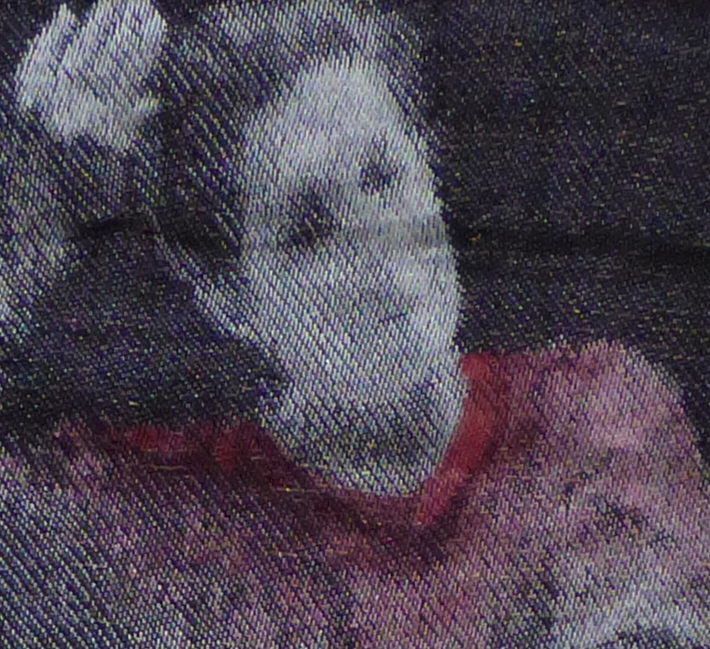
Hollie Meltzer, Lossy Format #1, crocheted "pixels," cotton floss, thread, poly organza backing
detail, Hollie Meltzer, Lossy Format #1
I just think it's terribly witty and maybe a little crazy to crochet approximately a billion tiny (about 1/2" diameter) circles to render a classical image in a pixelated format.  It feels very contemporary.  "Lossy format" indeed!

Hollie Meltzer did another pixelated face in a very different technique: 

Hollie Meltzer, Blow-Up, reverse applique, machine and hand stitching,
poly organza, cotton fabric, poly and cotton thread 

detail, Hollie Meltzer, Blow-Up
Where's the reverse applique?  The top layer of white poly organza is selectively cut away within the stitched grid to reveal gray fabric underneath.  Many of these gray squares are then hand-stitched with varying densities of dark line to make further value changes which in turn create the very blurred, pixelated image.


Sarah Warren, Long Night over the Canyon, Navajo wedge weave, cotton warp and hand-dyed wool weft
detail, Sarah Warren, Long Night over the Canyon, Navajo wedge weave, cotton warp and hand-dyed wool weft
I'd never seen wedge weave used to portray a landscape,  It seems like the perfect union of subject matter and technique to me, capturing the colors and stark landscape of the southwest.

Molly Elkind, Red Letter Day, tapestry, cotton, wool.
I'm honored to be in good company, next to a tapestry by Ruth Manning! 
I saw two other shows as well; those will have to wait for my next post.  The American Tapestry Alliance (ATA) had its very popular unjuried small format (under 10" in any direction) show. Tapestry Unlimited, at the downtown Milwaukee public library.  And  HGA's biennial Small Expressions exhibit of fiber pieces was at the fabulous Milwaukee Museum of Art.