When I started the 2017 diary these were my self-imposed rules or guidelines:
- weave each month's piece to finish 5" high x 7" wide;
- weave an indeterminate amount each day, responding both to the day and to what has been woven before;
- when away from the loom, do not weave;
- choose a palette of colors for each month but be open to adjusting the palette as necessary.
In addition, I decided on a sett of 8 epi on a 12/6 gray seine twine warp. I used my copper pipe loom and had to warp it twice over the course of the year. You can see that overall these rules are pretty loose; the most specific guideline is the overall size of each month's piece. My plan was to join each month's panel together to make an accordion book.
For the first few months, January to April, I did respond to what I saw on my morning walks, the colors of the sky, of blooming plants, the street itself, and so on.
 |
| Molly Elkind, January in progress, Book of Half-Hours, 2017 tapestry diary |
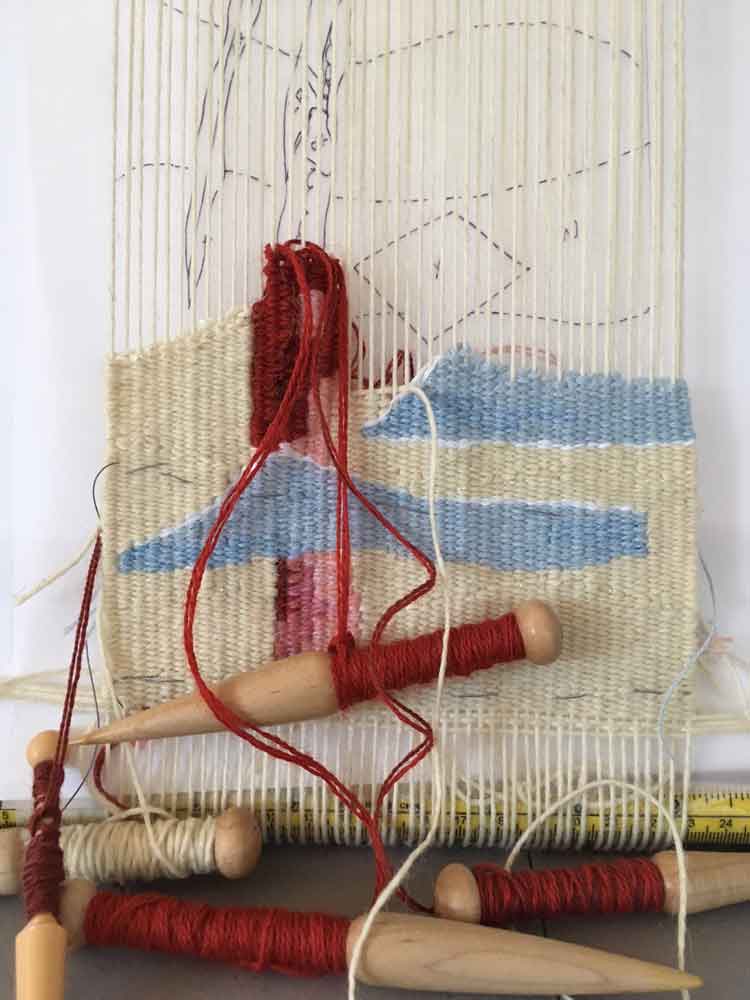
In February I marked off each day's weaving with a half-pass of red.
 |
| Molly Elkind, February in progress, Book of Half-Hours, 2017 tapestry diary |
In April I decided to take a big risk and included a found object in the weaving, a red mailbox flag I picked up off the street. This was a learning experience! I should have used half-hitches all around the flag to stabilize the warps as they were stretched around the thickness of the object. . .but I didn't. Live and learn.
 |
detail, April-May-June, Molly Elkind, Book of Half-Hours, 2017 tapestry diary.
|
In May, our schedule called for us to be away from home every weekend, so I devised a complicated system of colored squares and slits or interlock joins to indicate sequences of days spent at home or in another place. I tried to weave each day as a perfect square . . . but (another learning experience) noticed halfway through the month that my third woven week was developing a wavy top edge. One of my unspoken rules for the diary is not to un-weave if I can help it. So, I inserted a corrective strip of weaving in gray. Hey, I'm the artist, I get to make the rules, and re-make them, right?!
At this point it was becoming clear to me that the diary was evolving into a kind of tapestry sketchbook, in which I was trying out new ideas and techniques without much worry about whether they would make a cohesive whole or even always succeed technically. And that was fine. For me the important thing was to have a place to play and experiment.
At the beginning of June I had just returned from a wonderful retreat with
Tapestry Weavers South, at which
Connie Lippert had generously shared the basics of wedge weave. I set myself the challenge of weaving wedge weave, and changed the orientation so I'd weave that month from the side.
 |
| Molly Elkind, June in progress,Book of Half-Hours, 2017 tapestry diary |
In addition I decided to use only yarns from my scrap bag. This actually turned out to be one of my most successful months of the whole year, I think.
When I started the July diary the Fourth was looming and our national political situation was on my mind, so I decided to weave a heart composed of hatched lines of red and blue on a gray background.
 |
| Molly Elkind, July, Book of Half-Hours, 2017 tapestry diary |
In August I returned to the idea of incorporating objects I found in the street on morning walks. This time I chose thinner objects, and arranged them in a composition of sorts. The tweedy background was meant to mimic the texture of the street. I think now I've got found object weaving out of my system!
 |
| Molly Elkind, August, Book of Half-Hours, 2017 tapestry diary |
In September I chose to use only scrap yarns again, and only horizontal lines. Partway through the month, though, I saw a discarded sunflower in the street on my morning walk and decided to incorporate it too.
 |
| Molly Elkind, September, Book of Half-Hours, 2017 tapestry diary |
In October I adapted an old watercolor sketch, changing up the values and colors and again using scrap yarn. Only darks were left in the scrap bag, so that's what I used. I was happy with how this one turned out too.
 |
| Molly Elkind, September, Book of Half-Hours, 2017 tapestry diary |
In November I decided to do a study of textures, seeing how many different techniques I could use to create texture. I also limited myself to a light palette this time. Techniques included twill, twining, double and triple setts, countered soumak, slits, rya knots, eccentric weaving, twining, and plain weave with lazy lines.
 |
| Molly Elkind, November, Book of Half-Hours, 2017 tapestry diary |
In December, I happened on a diagram of regular hachure and hatching in Kathe Todd-Hooker's book
Line in Tapestry (available
here. While you're there check out Kathe's blog as well).
 |
| (c) Kathe Todd-Hooker, Line in Tapestry, p. 26. Reproduced with permission. |
Upside down, it looked like a Christmas tree so I decided to practice this technique, using green Churro singles for the tree and fine tapestry wool for the background. In a nod to my 2016 diary which tracked the colors of the liturgical calendar, the background moved from purple to white over the course of the Advent season. You can see this image at the top of this post.
I still have to do the finishing work on these last several months and join them to the January-July segments to make a complete book.
Meanwhile, I've warped up my Mirrix to be ready to start the 2018 diary in a couple days. Like the new year, an empty warp is pure potential, don't you think?
 |
| 2018 tapestry diary warp: 12/6 seine twine, 10 epi, 5" wide |
If you are thinking of starting your own tapestry diary, it's a good idea to give a little thought to your starting guidelines. To quote a
previous post:
Settling on these initial guidelines is an important and subtle part of the game. You want to have rules, as it were, to govern the game and to make the artistic choices you face each day limited enough to be manageable. On the other hand, you want those rules to be spacious and generous enough to allow for spontaneous creative responses to circumstances and inspirations. . . and for those inevitable days when you just can't get to your practice. You don't want to set such strict rules that you get bored or frustrated.
For further information about tapestry diary practices, check out these links:
An expanded version of this review will appear in the next edition of the American Tapestry Alliance's member newsletter, Tapestry Topics. If you're an ATA member, you'll see it. If you're not, and you're a tapestry weaver, consider joining ATA!
Let me know if you plan to start a diary (it doesn't have to start on January 1 or even run a whole year!). And share some pictures, below in the comments or on find me on
Facebook or
Instagram. I'd love to see what folks are doing!