Showing posts with label Mary. Show all posts

Wednesday, November 9, 2022

Impressions of Italy

 If you've been following me on Instagram (@mollyelkind) or Facebook you have already seen a few posts about our recent trip to Italy.  If you are tired of hearing about it, feel free to skip this post!  However, as the saying goes, wait. . . there's more!  I've just uploaded the photos from my actual camera (not my phone), and I've had some more time to digest what we saw and did, so I thought I'd share some further thoughts.  

We spent four days in Florence, where we were fully immersed in late medieval and Renaissance art, as one is in Florence.  One theme that struck me almost right away was the varied depictions of women in art, so here's a few of those that I didn't share on social media.  It should come as no surprise that the depiction of women in art is varied to say the least, perhaps even more so than that of men (generally depicted as heroes of some kind).  Women are varied.  A woman can be the mother of God, or the personification of poetry, music, and art, or any number of allegorical virtues, or the victim of rape, or the avenger of rape.  She can be the redeemed prostitute (in an outmoded conception of Mary Magdalen) or an idealized goddess.  In Renaissance painting she is most often a symbol, rarely an individual (with the exception of portraits of duchesses and so on). 

Botticelli, Madonna of the Pomegranate (detail), tempera on wood, c. 1487

Fra Angelico, Annunciation (detail), fresco, 15th c. 

Giorgio Vasari, allegorical personification of Art, Casa Vasari, fresco, 16th  c.

Botticelli, Fortitude, tempera on wood, 1470 


Titian, La Maddalena (the Magdalen), detail, 15th c. 

Artemisia Gentileschi, Judith Slaying Holofernes (detail),  oil on canvas, 1620-21. 

After our time in Florence we joined a Road Scholar tour group on a tour of "hidden villages of Tuscany and Umbria."*  In those places the vibe was definitely medieval, if not Roman and Etruscan.  The tiny walled towns with their towers, castles, and steep narrow streets were incredibly picturesque and fun to explore.  But after having guided tours of Anghiari, Cortona, Arezzo, Gubbio, Spoleto, Perugia, and Orvieto, it became clear that these beautiful towns are the relics of a time of constant war, among competing tribes and dukedoms, the Pope(s) and foreign powers.  Hence the defensive walls, towers and castles.  

Wall in Anghiari 

Anghiari

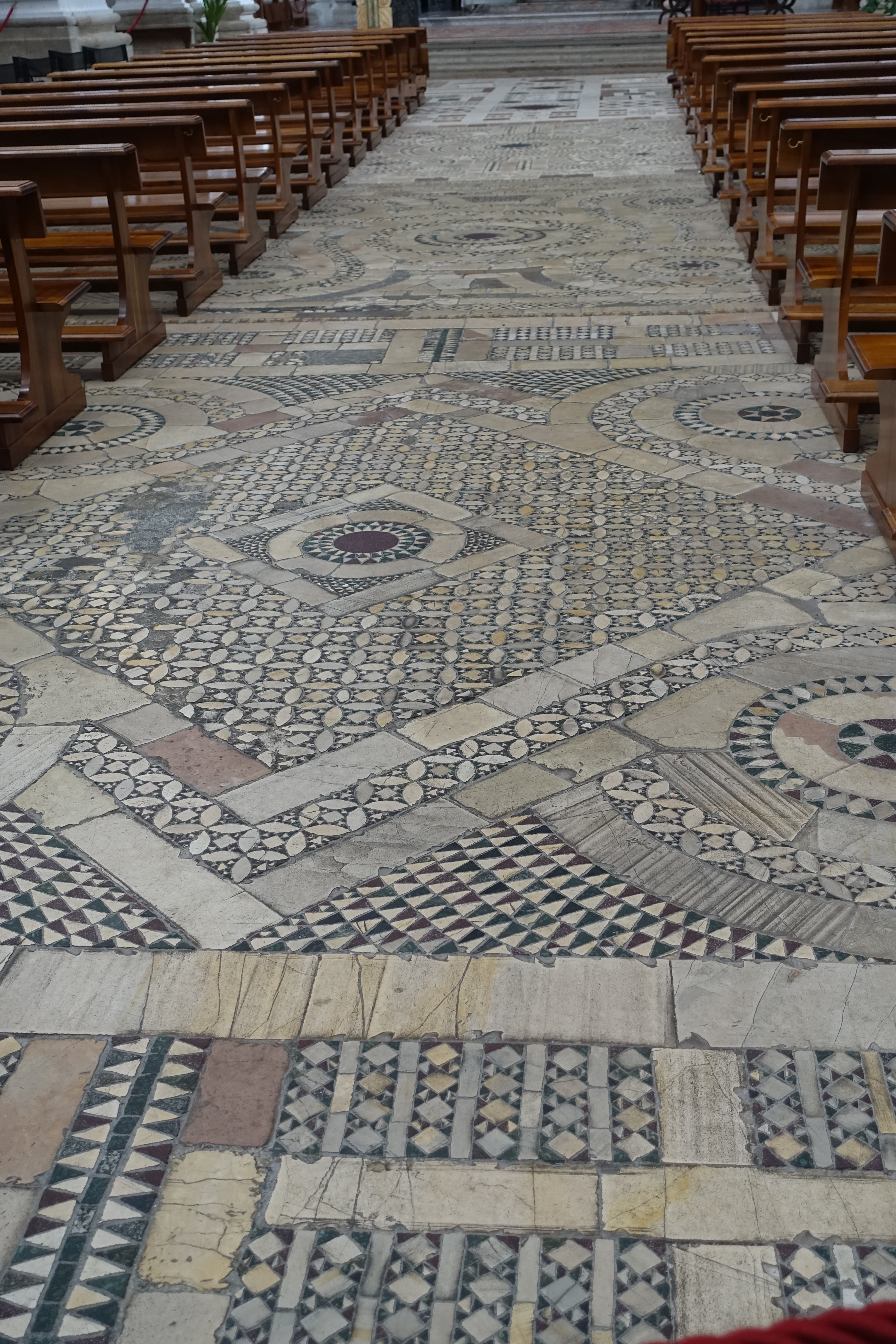
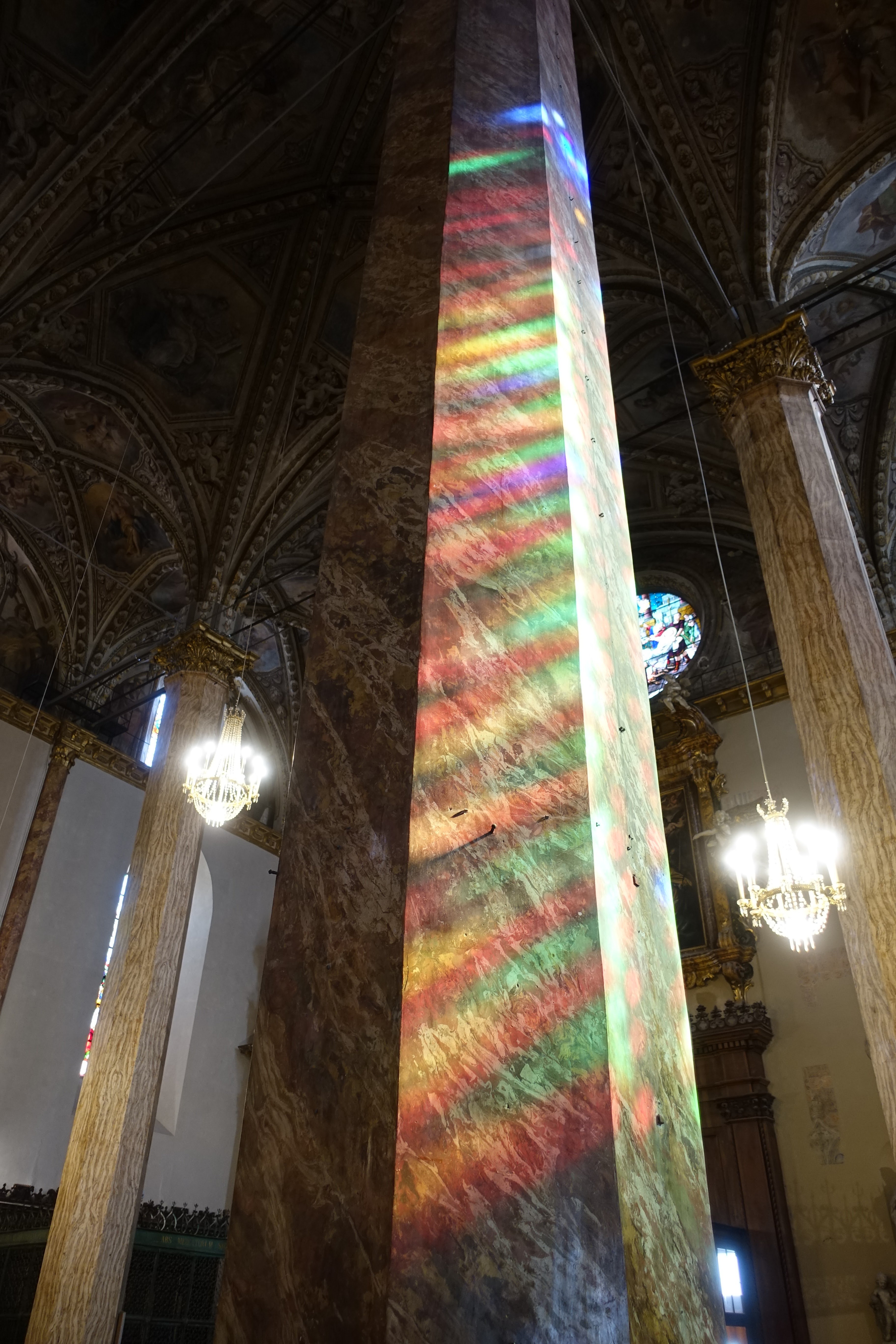
The towns also contain awe-inspiring churches and cathedrals and stunning art. The art is entirely on religious and classical themes.  Even I, with my long-standing interest in depictions of the Virgin Mary, found my eyes glazing over after seeing so many Madonnas.  So I started noticing other things--the evocative fragmentary frescoes, the play of light through stained glass, the layers of patterns everywhere.  After a time I found that I enjoyed the austere, heavy Romanesque churches with limited decoration as a refreshing counterpoint to the lavish Gothic cathedrals.  


My thoughts turned to how we experience the sacred, specifically where, when and in whom (or in what) it is embodied for us, beyond theological doctrine.  Even more, how do we attempt to capture and hold on to that experience?  We make paintings, churches, cathedrals, and pilgrimage sites.  And we make our own small gestures of devotion in public places, even today.  We try to link the numinous sacred to the visible and tangible, so that we can touch that experience again and again.  Pilgrims at La Verna, a site sacred to St. Francis, used what was at hand to fashion crosses.


I don't think there will be any direct influence of what I saw in Italy on my own work, except perhaps to nudge me to explore again the impact of pattern.  The world has changed in 500 years, and what we expect art to be and do has changed with it.  My own work now is mostly about place and landscape, and that is virtually non-existent in Renaissance art.  But for me it was, in the end, inspiring and consoling to see that not only can we create works of art that embody our highest hopes for what humans can be and do, we continue to be moved by that art centuries later. 

Sunrise and fog over Anghiari

*If you hit this link to Road Scholar's site, you will find that the tour's title and itinerary have been tweaked slightly from the one we experienced.  

Wednesday, May 23, 2018

Recall-Recapture-Remember fiber exhibit at Tansey Contemporary

I had the distinct pleasure of visiting the above-named exhibit the other day in Santa Fe.  An important family celebration kept me away from the opening last weekend, timed to kick off the 2018 New Mexico Fiber Crawl, but I hear it was a hoot.  The show remains up in Santa Fe through June 17, when it will travel to Tansey's Denver gallery for July 7 - August 5.

This exhibit, sponsored by the Espanola Valley Fiber Arts Center (EVFAC) in collaboration with Tansey Contemporary Gallery of Santa Fe and Denver, showcases invited and juried artists from the Southwest region.

Tansey Contemporary Gallery, 652 Canyon Road, Santa Fe, NM
The show's theme was expressed in this way:  "Does our past build us, or do we build our past?  Things remembered can be as sharp as the current moment or so blurred that only a feeling remains."

This dovetails nicely with the questions I've explored in my Mary series, questions about the ongoing impact of the image and myth of the Virgin Mary for women down the millenia.  I was thrilled when my piece Mary (Yes) was accepted.

Mary (Yes) by Molly Elkind back left;
In Mind by Amanda Speer back right 

There is much to see in this show, and work by other Tansey gallery artists is also on exhibit so the space is chock-full of cool stuff to look at.  I would love to share all the fiber pieces with you, but time and space do not permit.  And in fact there is a complete slideshow HERE and an online catalog with artists' bios and statements HERE , so you can browse to your heart's content.  I recommend taking the time to read the artists' statements.  Here I will focus on the work of those weavers whose work captivated me on this visit.  I plan to revisit the exhibit and imagine I will find more work that pulls me in then.

For me it was a thrill to see this piece by Elizabeth Buckley in person after having only seen it on a screen. 

Elizabeth Buckley, The Veils of Time, 60" x 50".
Elizabeth's mastery of values, hues, subtle color gradation and transparency in tapestry are breathtaking.  She fully exploits the techniques of the medium to serve her image without letting the techniques become an end in themselves.  And the image itself conveys a sense of layers of deep time in the landscape, alluding to the sea that used to cover much of New Mexico.

detail, Elizabeth Buckley, The Veils of Time, 60" x 50"

detail, Elizabeth Buckley, The Veils of Time, 60" x 50"
I could study and learn from this tapestry for a long time. 

I could say the same of Cindy Dworzak's piece Circles.

Cindy Dworzak, Circles, 39" x 37"

Again, my eye delighted in the subtle gradation of colors, the use of transparency, the masterful tapestry techniques employed . . . and all those overlapping circles!  Circles are probably the most difficult shape to weave in a medium based on the grid, and here Cindy has woven bunches. . .and made it look effortless.  I was interested to learn that for Cindy this piece recalls her mother's love of color and the complexity of her personality. 

detail, Cindy Dworzak, Circles, 39" x 37"

detail, Cindy Dworzak, Circles, 39" x 37"
Speaking of grids, a couple of artists explicitly acknowledged the woven grid while at the same time bending it to their own will.  These pieces prompted me to wonder "How did they do that?"  I do recognize various shadow-weave patterns in Amanda Speer's piece but in the brief time I had I couldn't tease out how she managed to blur their edges and transition between them.  A look at her statement disclosed that she works with ikat dyeing.  This piece, with its mosaic of color and complex pattern set off by a black border, is dedicated to the 36 young people who perished in the "Ghost Ship" warehouse fire in Oakland, CA in December 2016.

Amanda Speer, In Mind, 38" x 38"

Jennifer Moore is well-known for exploring the possibilities of doubleweave.  She writes that this piece's design revolves around fractals based on the golden proportion.  The central rectangle spins off smaller, proportional rectangles in multiple generations. . . much as the human family reproduces itself and its cultures.  I have a very general understanding of how Jennifer wove this but I marvel at the nuances of color gradation and luminescence she achieves.

Jennnifer Moore, Introspection, 40" x 30.5" 
I must include a look at two more tapestry artists before closing.  Navajo/Dine' weaver Titus Steiner Cody wove a piece that is rooted in Navajo methods and imagery and yet feels utterly contemporary.

Titus Seiner Cody, Somewhere Triptych, 37" x 68"
Cody credits the influence of his grandmothers, both in teaching him to weave and in handing down the creation stories of the Navajo, which are pictured in this piece. Again, there is much to see and to study here.

detail, Titus Seiner Cody, Somewhere Triptych, 37" x 68"

detail, Titus Seiner Cody, Somewhere Triptych, 37" x 68"
Finally, Irvin Trujillo included a piece informed by a number of influences:  his own multiple-generation heritage of Rio Grande weaving, the patterns in a Tunisian headscarf he observed in a Santa Fe museum, and the protests of the Arab Spring that occurred during the time he wove the piece.  Because he was limited to a small loom at the time, the piece was woven in two strips and seamed down the center.  The weaving is of course meticulous. 

Irvin Trujillo, Emergence in Tunisia, 80" x 48"
I was interested to note that this piece is woven in half silk, half merino wool, at a very fine sett.

detail, Irvin Trujillo, Emergence in Tunisia, 80" x 48"
There is so much more to see in this exhibit than I have presented here so briefly, fascinating and gorgeous works in stitch, sculpture, quilting, and mixed media.  If you are in Santa Fe or will be in Denver in June, I urge you to see the show.  Or at least curl up with the online catalog HERE. 


Wednesday, February 28, 2018

Pictures from ICONIC Exhibition, part 1

Last Sunday we had the opening reception for my show of tapestries entitled ICONIC.  I was so happy that so many friends and colleagues braved the rain and came out to Southeast Fiber Arts Alliance (SEFAA). 

Photo courtesy Marilyn Kleinhans

Photo courtesy Marilyn Kleinhans

I gave a short artist's talk and was really gratified to hear such thoughtful questions.  Here I'm discussing Mary's Cloak, part of the My Real Name is Mary series.

Photo courtesy Sam Elkind
Mary's Cloak is the one non-tapestry work in the show.  It's inspired by something I read during my preparatory research:  "Mary's azure cloak has been a heavy one for women to bear."  The outside of the cloak is blue velvet, trimmed in gold, typical of Mary's clothing in paintings throughout the centuries (if not historically accurate).  The inside of the cloak is a red rose-printed cotton.  It is collaged with tissue garment patterns.  The pattern tissues are overlaid with images of Mary from paintings throughout history.  These images have been scanned, printed on fabric, and "framed" with ribbons or lace.  In my handwriting the words "ecce ancilla Domini" ("behold the handmaid of the Lord") are repeated over the surface.  At the bottom a scalloped border of beads and fishing weights adds the weight to the cloak.  The label encourages viewers to take it down and try it on.

Mary's Cloak (c) Molly Elkind 2018
71" x 61"
Photo courtesy Sam Elkind
Mary's Cloak (c) Molly Elkind 2018
Photo courtesy Marilyn Kleinhans

Left to right:  Mary (the anxiety of influence), Mater Dolorosa, Mary's Cloak, Mary (Yes)
all (c) Molly Elkind 2017, 2018
Photo courtesy Sam Elkind
Mary (the anxiety of influence) (c) 2017 Molly Elkind
45" x 37"
Photo courtesy Sam Elkind
Mater Dolorosa (c) Molly Elkind
27.5" x 19"
Photo courtesy Sam Elkind
Mary (Yes) (c) Molly Elkind 2017
28" x 19.5"
Photo courtesy Sam Elkind
Here are the earlier pieces in the Mary series:

Mary (a sword shall pierce) (c) Molly Elkind 2013
11.5" x 17.5"
Photo courtesy Sam Elkind
Mary (gilded) (c) Molly Elkind 2014
21.5" x 20"
Photo courtesy Sam Elkind

Mary (greater is what she bore in her mind) (c) Molly Elkind 2015
19" x 15"
Photo courtesy Sam Elkind

Mother/Mary (c) Molly Elkind 2015
15.5" x 15.5"
Photo courtesy Sam Elkind
If you want to know more about the ideas behind this series, click HERE.  Or ask a question in the comments below!

Next time I'll share the other series in the show, Book of Hours, inspired by illuminated manuscripts.


Wednesday, November 23, 2016

Adventures in drawing

Here's my dirty little artistic secret:   I can't draw.  Or maybe I should rephrase that, since I always give my students a hard time when they say they can't do something.  I don't draw.  I've never had a drawing class and I don't practice drawing nearly enough to be as good at it as I'd like.  (I'm speaking here of realistic drawing, the attempt to render an accurate likeness.)  

One way I've found to conquer my drawing anxiety and even sometimes made some interesting drawings, is to do blind contour drawing.  Basically the idea is you slowly run your eyes along the contours of an object and use your pencil to trace those contours, without looking at the paper or raising your pencil from the paper at all.  Obviously it will not be an accurate likeness, but the lines that result can be sensitive and engaging. You can find a good 3-minute video tutorial HERE.  I've also used the instructions in the classic book by Betty Edwards, Drawing on the Right Side of the Brain.

I did a blind contour drawing of a hanging plant several years ago that I really like.  I love how it conveys the feeling of an organic descending form without the fussy detail.

U


More recently, on a trip to New Mexico, I stayed in a home where bleached animal skulls of various types and sizes decorated the outdoor patio space.  I really enjoyed photographing and then doing blind contour drawings of this cow's skull:


I love how the contour drawing (done from a side angle) captures the weird shapes and energetic lines of the skull and teeth.


I also did a blind contour drawing of a large wooden bowl.  Simple, but I find it amusing that the shape isn't closed and the edges not connected.


I also drew a candle holder with interesting Aztec-type figures.


I've learned that the most interesting blind contour drawings are of complex objects.  If the object's outlines are too simple there is not much room for eccentric lines and shapes to develop.

For the past week or so I've been working on the design for the next tapestry in my Mary series, a piece on the Mater Dolorosa (sorrowing mother) theme that is one traditional type of Mary icon.  The icon I've been using as my source for previous tapestries depicts a placid Madonna.


I needed a face that expressed grief and sorrow.  Lacking any handy sources, I made a face and snapped a quick selfie.  I deliberately posed looking downward.  Possibly the most unattractive selfie ever!  Go ahead and laugh!


Then I made a quick and loose sketch of the selfie face, adding the iconic veil.  I was eager to plug this image into an overall composition I had in mind so I worked fast and didn't belabor the sketch.


I don't want to overstate this, but this is possibly the loosest, most expressive drawing I've ever done. Maybe all that low-stakes blind contour practice recently loosened me up. Maybe I did the sketch quickly enough that I didn't give myself a chance to get all tight and nervous about drawing.

Today I tried another version, also based on a selfie, with open eyes this time, and the head tilted slightly the other way.


This one I labored over a bit more, and it shows.  Not sure yet which one I'll use in the piece.  Back to the studio. . . .

Have you ever experimented with blind contour drawing?  What was it like for you?